Showing posts with label lifer. Show all posts

Saturday, September 13, 2025

My Finland mammal life list


Updated: 23.3.2026

Latest addition: Eurasian least shrew (Sorex minutissimus)

This is my life list of wild mammal species I have either seen, or heard here in Finland. 

Carnivorans (Carnivore)

1.      Raccoon Dog (Nyctereutes procyonoides ussuriensis)

2.      Red Fox (Vulpes vulpes)

3.      Eurasian Wolf (Canis lupus lupus)

4.      Feral Cat (Felis catus)

5.      Eurasian Lynx (Lynx lynx)

6.      Eurasian Otter (Lutra lutra)

7.     Wolverine (Gulo gulo)

8.      European Pine Martin (Martes martes)

9.      Eurasian Badger (Meles meles)

10.     Stoat (Mustela erminea)

11.    Weasel (Mustela nivalis)

12.    European Polecat (Mustela putorius)

13.    American Mink (Mustela vison)

14.    Grey Seal (Halichoerus grypus)

15.    Baltic Ringed Seal (Pusa hispida botnica)

16.    Saimaa Ringed Seal (Pusa saimensis)

17.    Walrus (Odobenus rosmarus)

18.    Brown Bear aka Grizzly Bear (Ursus arctos)

Even-toed ungulates (Cetartiodactyla)

19.    Mouflon aka Red Sheep (Ovis orientalis)

20.    Moose aka Eurasian Elk (Alces alces)

21.    Finnish forest reindeer (Rangifer tarandus fennicus) 

22.    European Roe Deer (Capreolus capreolus)

23.    Fallow Deer (Dama dama)

24.    White-tailed Deer (Odocoileus virginianus)

25.    Wild Boar (Sus scrofa)

Bats (Chiroptera)

26.    Northern Bat (Eptesicus nilssonii)

27.    Brandt's Bat (Myotis brandtii)

28.    Whiskered Bat (Myotis mystacinus)

29.    Daubenton's Bat (Myotis daubentonii)

30.    Natterer's Bat (Myotis nattereri)

31.    Pond Bat (Myotis dasycneme)

32.    Noctule (Nyctalus noctula)

33.    Nathusius' Pipistrelle (Pipistrellus nathusii)

34.    Brown Long-eared Bat (Plecotus auritus)

Eulipotyphla (Eulipotyphla)

35. Western European Hedgehog (Erinaceus europaeus)

36. European Mole (Talpa europaea)

37. Eurasian Water Shrew (Neomys fodiens)

38. Eurasian Shrew (Sorex araneus)

39. Laxmann's Shrew (Sorex caecutiens)

40. Taiga Shrew (Sorex isodon)

41. Pygmy Shrew (Sorex minutus)

42. European Least Shrew (Sorex minutissimus)

Lagomorphs (Lagomorpha)

43. European Brown Hare (Lepus europaeus)

44. Arctic Hare aka Mountain Hare (Lepus timidus)

45. European Rabbit (Oryctolagus cuniculus)

Rodents (Rodentia)

46. American Beaver (Castor canadensis)

47. Eurasian Beaver (Castor fiber)

48. Eurasian Water Vole (Arvicola terrestris)

49. Field Vole (Microtus agrestis)

50. Sibling Vole (Microtus rossiaemeridionalis)

51. Tundra Vole (Microtus oeconomus)

52. Bank Vole (Clethrionomys glareolus)

53. Grey-sided Vole (Clethrionomys rufocanus)

54. Red Vole (Clethrionomys rutilus)

55. Wood Lemming (Myopus schisticolor)

56. Norwegian lemming (Lemmus lemmus)

57. Muskrat (Ondatra zibethicus)

58. Northern Birch Mouse (Sicista betulina)

59. Striped Field Mouse (Apodemus agrarius)

60. Yellow-necked Field Mouse (Apodemus flavicollis)

61. Eurasian Harvest Mouse (Micromys minutus)

62. House Mouse (Mus musculus)

63. Brown Rat (Rattus norvegicus)

64. Siberian Flying Squirrel (Pteromys volans)

65. Eurasian Red Squirrel (Sciurus vulgaris)

Cetaceans (Cetacea)

66. Common Bottlenose Dolphin (Tursiops truncatus)

-----------------------------------------------------------------------------------------------------------------------------

Author

Olli Haukkovaara

email: olli.haukkovaara @ proton.me

Valkeakoski
Finland

Tuesday, July 15, 2025

Trip to southern Norway, 2 new lifers


Day 1

The trip started on the 6th of July 2025 from Valkeakoski, Finland, from where I drove to Helsinki with my family. Next step was the boat trip by Silja Symphony ferry from Helsinki to Stockholm, Sweden. During first day I didn't see many mammals, only some roadkills on Highway 3 to Helsinki i.e. Eurasian Squirrel (Sciurus vulgaris) and couple of Raccoon dogs  (Nyctereutes procyonoides) and from the ferry I spotted the Grey Seal (Halichoerus grypus) on Gulf of Finland, close to Porkkala, at Kallbådan seal reserve area.

Day 2

During the drive from Stockholm to Oslo, we saw few Roe Deers (Capreolus capreolus) in the fields of Sweden, and some roadkills, of which the only identified one was the Eurasian Badger (Meles meles). In Oslo, we had rented an Airbnb apartment for one week. So, this trip was not a full mammal watching trip, but anyway, during a week, I had a enough time to spend outdoors in the nature.

Day 3

During the third day, on the 8th of July, we started very early in the morning and drove about 350 km north, to Dovrefjell–Sunndalsfjell national park. During road trip, we saw a Roe Deer (Capreolus capreolus) in two places, a single one in a field and propably a pair in another field. I had hoped to see a Red Deer, but no luck this time.

We arrived to Dovrefjell–Sunndalsfjell national park at 9:30, signed in to the Muskox Safari and at 10:15 we started the hike up the mountains near Kongsvoll Botaniske Fjellhage.

The weather was fine, not too cold nor too hot. While climbing up to Nystugguhøa, my younger son Roni heard a rustling from the downy birch forest. There was some vole, possibly a Tundra Vole or Norway Lemming, but unfortunately we did not see it.

We continued the climbing and finally one of my mammal dreams came true, when our guide spotted two Muskoxen (Ovibos moschatus) resting in the snow - almost on the top of the Nystugguhøa mountain. A lifer for me! After that we found more of them and the final count was 16! A small surprise for me was the size of Muskox, it's much smaller than I thought. The Muskox stands at 1.1 to 1.5 m (3 ft 7 in to 4 ft 11 in) high at withers.


The first Muskoxen, cool off in the snow at Nystugguhøa.


A solitary Muskox lower at the slope of Nystugguhøa.


Muskox herd a bit further away at the slope of Nystugguhøa.

While driving back to Oslo in the evening, we chose another route, a bit further east. During evening hours, we saw one Red Squirrel (Sciurus vulgaris) running over the road. Also, one Mountain Hare (Lepus timidus), but unfortunately, it was a roadkill. There were no Red Deer in sight that evening, but Roni probably saw two Elks (Alces alces) for a few seconds in a roadside forest near Oslo.

Day 4

This day was spent almost entirely recovering from the previous day's relatively strenuous mountain hike. Still, during late evening, I started a new hike, a couple of kilometers walk along the river Akerselva, from the lake Maridalsvannet downstream to the Nydalen. Near Kjelsås, there was a sign which claimed that there lives Eurasian Beavers in the river. But... I must say now that it's a false information. I didn't see any beavers, nor any recent signs of them nesting or feeding along the river. Only some very old signs in trees, probably from many years ago. 


I tried to also find the Wood Mouse, but no luck with it. Actually, I did not see a single rodent during evening, maybe they have a bad year in southern Norway?

But... the bats surprised me! There was a lot of bats along the river and many species of them! Here's the complete list of the 5-6 bat species, that the Echo Meter app identified and some screen shots from the app.

  • Northern Bat (Eptesicus nilssonii)
  • Daubenton's Myotis (Myotis daubentonii)
  • Brandt's Myotis / Whiskered Myotis (Myotis brandtii / Myotis mystacinus)
  • Brown Long-eared Bat (Plecotus auritus)
  • Soprano Pipistrelle (Pipistrellus pygmaeus)
In addition to the list above, Echo Meter app provided three more species; Western Barbastelle, Natterer's Bat and Pond Myotis. It seems that the Western Barbastelle and Natterer's Bat were false positives but the Pond Myotis recording is still possible and under investigation, especially because the species should not exists in Norway i.e. it would be a new species for Norway! I will update this blog article, when the species is clear.

Day 5

This day was spent in downtown. Still, one mammal observation, the Red Squirrel (Sciurus vulgaris), this time in Slottsparken, which is the park surrounding the Royal Palace of Norway, with ponds and statues.


Red Squirrel at Slottsparken

Day 6

At midday, we went to the Natural History Museum in Oslo. Very interesting place, highly recommended for all mammal watchers. The museum is surrounded by Botanical Garden. While walking around the garden, I suddenly noticed two Roe Deers (Capreolus capreolus) - a small surpise in a fenced park in the middle of Oslo.


A Roe Deer pair at Botanical Garden.

In the evening, I spent again about three hours in the forests along the river Akerselva, walking slowly around, listening for possible rustlings and watching for possible moves of grass and flowers. I had almost given up, when I heard a rustling sound. I stopped and crouched down, the rustling sound moved closer. And suddenly, from behind a tree, a Wood Mouse (Apodemus sylvaticus), walked to the path, right in front of me, it was about 70 cm away from me. A lifer for me! We stared each other about 15 seconds, and I was able to see it really nicely; small size, pure white chest and belly, small ears an eyes and brownish gray back. No photo though, I didn't want to scare it so I just stayed on my site like a statue.

Day 7

The last day in Oslo, no wild mammal obervations. A note about the House Cats: it seems that it's legal in Norway to let them be out without any control. Around our Airbnb apartment, there was at least four House Cats wandering around.


Bengal Cat at Kjelsås.

Day 8

The travel back to Finland started in the morning. While driving from Oslo to Stockholm, we saw again many Roe Deers (Capreolus capreolus) in the fields - but that's all. No Red Deers anywhere during this trip, even though they exist in Southern Norway and Sweden. I just wonder whether they are so nocturnal, that they are hard to see?

Another species that was totally missing in this trip, was the European Hare. Why, I'm not sure, perhaps the grass in the fields was already so long that all smaller mammals disappeared there.

Day 9

When I woke up in the Bay of Finland, there was a thick fog i.e. very poor visibility. Luckily the fog faded away after an hour and I managed to see again Grey Seal (Halichoerus grypus), at Kallbådan seal reserve area, this time three of them. 

While driving back to home from Helsinki, there was again several roadkills on the Highway 3, all identified mammals were Raccoon dogs  (Nyctereutes procyonoides).

This was my third visit in Norway - but not the last. I have plans to go to a whale trip in Andenes and to another trip further north to Svalbard island, to see Polar Bears and other arctic mammals and birds.

-----------------------------------------------------------------------------------------------------------------------------

Author

Olli Haukkovaara

email: olli.haukkovaara @ proton.me

Valkeakoski
Finland

Sunday, July 16, 2023

Looking for the arctic fox & norwegian lemming


In July 2023, I made a five-day trip to Kilpisjärvi, an arm of Finland, which is a tundra/mountain area of Lapland. I've only been there once before, very briefly, just for a day trip. Not that I didn't want to go there, but only now I managed to lure one of my old friends with me. Aatu Rundgren, whose roots are in Lapland, joined me! 

Our goals were to find certain new mammal species for me, and several new bird species for Aatu. He is also interested in mammals, and I'm interested in birds as well, especially rare / scarce arctic birds this time. My ultimate goal was the arctic fox, and the other goal was the norwegian lemming, both species that I had never seen.

Day 1 - 10th of July 2023

And so we drove 14 hours to far north! The trip started early in the morning of 10th of July and we arrived at Kilpisjärvi about at 21:00 in the evening.


During this long drive we saw couple of rough-legged buzzards and one northern hawk-owl, which was a clear indication that vole populations were in good condition.

Our original plan was to stay at Kilpisjärvi Holiday Village & Camping area. But when we arrived there, they told that there was no space for our tent... Damn! July is the busiest time there, lot's of tourists everywhere, all cabins and tent places booked. So, we had to create quickly a plan B. Suddenly I remembered that there is the Kilpisjärvi Biological Station, a sub-arctic research station run by the University of Helsinki. We drove to station and I called to the station manager, who luckily gave us a permission to put up our tent and stay in biological station next two nights! For the last two nights, we had already managed to book a small cabin.

During first evening, we succeeded in finding couple of voles close to our tent, near the shore of the Lake Kilpisjärvi. The first one was a grey-sided vole (Craseomys rufocanus) and the second a northern red-backed vole (Myodes rutilus), both new to my year list 2023. 

Day 2 - 11th of July 2023

After the morning swimming in lake Kilpisjärvi and breakfast in Kilpisjärvi Holiday Village, we headed to our first target, the Mount Saana. The easiest way to Saana was to drive to Norway to the coast of Arctic Ocean and then back towards the arm of Finland via small mountain road. While approaching our target, we saw lot's of northern birds, like the european golden plovergolden eagle and rough-legged buzzards. The mountain road was in really bad condition, luckily my Nissan X-trail has a high ground clearance. Some other Finnish tourists were not so lucky with their low ground clearance cars...

The road ended close to the border between Norway and Finland. We continued by hiking up to mountains. The trail was really challenging and we proceeded slow.


The scenery around us was amazing. We were in the middle of nowhere, the only people in this remote wilderness. Up on top of the mountains, we used our binoculars to scan the entire 360-degree landscape around us, looking for an arctic fox. But no, we couldn't find the arctic fox, even though we really tried...

After couple of hours of hiking, we decided to give up and walk back to the parking place. We chose another route, which was easier to walk, but few kilometers longer. This route was a green Lapland mountain moorland, with more birds. There we noticed many holes on the ground, next to stones. Clearly some vole holes, hmmm, could they be norwegian lemming holes?

And yes, that they were! Suddenly I noticed a norwegian lemming (Lemmus lemmus) peeking from one hole! A lifer! Species #102 in my global mammal life list!

It was already an evening when we got back to car. While driving back to Kilpisjärvi, we stopped on the coast of the Arctic Ocean and had a refreshing swimming session, water temperature was about 10 degrees Celcius.

Day 3 - 12th of July 2023

In the morning we moved from Biological Station to a cabin that we had rented. When we left the station we saw a big vole coming over the road towards us. It was a tundra vole (Alexandromys oeconomus), a nice addition to my yearlist 2023!

Today we decided to climb to Mount Saana, to look for the norwegian lemming in the Finland. And rock ptarmigan for Aatu. Weather looked great, not much clouds in the sky and refreshing wind.

View from Saana to west.


The scenery was again amazing... but the wind got stronger all the time and finally it blow about 25 m/s. A storm in a sunny day! It was difficult to walk on the top, because of the storm, and there was nothing but tourists, so we decided to hike to calmer side of the Saana. All the birds were now there, but we did not find any rock ptarmigans. Nice surprise was the long-tailed skua, a lifer for Aatu!

On the northern slope of Saana, there was a large grassy moorland area. We noticed again vole holes next to stones. And soon there was again a norwegian lemming peeking from the hole! #64 in my Finland mammal life list ! We hiked further away from Saana, towards Mount Iso-Jehkas. But no signs of an arctic fox here either. So, rest of the day was spent on birdwatching. 

Day 4 - 13th of July 2023


Today our target was the Three-Country Cairn, which is the point at which the international borders of Sweden, Norway and Finland meet, and the name of the monument that marks the point. It is an example of a geographical feature known as a tripoint. It is the northernmost international tripoint in the world. We had planned to hike there, but the weather forecast changed a bit our plan, as a rain-front was approaching from west. So we bought tickets to ship which sailed us to Sweden, only two kilometers away from tripoint. 

From Three-Country Cairn we started to hike through Mount Malla nature reserve back to Kilpisjärvi. We saw lots of birds, including white-tailed eagle, pair of rough-legged buzzards in their nesting site, bluethroats and we found also two nests of ring ouzels, again a lifer for Aatu!


In Malla we got the best view and first photos of the norwegian lemming. It was so cute! The rain-front approached us fast so we had to walk bit faster too. We scanned the landscape all the time, in hope of arctic fox, but found nothing...  Luckily the rain never reached us and we got back to cabin in time. 

Day 5 - 14th of July 2023

Time to drive back to south...  Reindeers were every here and there, but for a mammalwatcher it's just another domestic animal. I was hoping the see the Finnish forest reindeer (Rangifer fennicus fennicus) while driving home, but didn't have luck with it this time. 


The arctic fox had two breeding pairs in Finland 2023, another pair in Kaldoaivi wilderness area and another somewhere in the arm Finland, where we hiked. I really must come back to Kilpisjärvi - or Kaldoaivi in future. I really want to see that gorgoeus arctic fox some day!

Sunday, June 25, 2023

Perfect midsummer night with bear and wolverines!


During summer 2023, one of my dreams came true. We travelled to Lieksa, which is located in eastern Finland. In Lieksa, there are photography hides of Erä-Eero, where you can see and take photos of wolverines, bears, wolves and fox as well as several species of bird of prey.

My son Roni and I, arrived to Erä-Eero's Keljänpuro Lodge during afternoon, 23rd of June. After a coffee break, we drove to nearby Uuronlampi pond, where we stayed awake the whole night. In these latitudes the summer nights are luminous, almost as light as days, so it was easy to follow what happened around us.

At 16:32 we heard a rustling noice behind us and suddenly the first wolverine (Gulo gulo) arrived! A lifer for me, number #101 in my global list, and number #63 in my Finland list. Before this, I had seen only the footprints of wolverine in snow, about 10 years ago, in Valkeakoski.

At the closest, this first wolverine was only 1,5 metres away from us! It's a gorgeous animal indeed! While following it's activities I realised also how difficult this species could be to find in forests as the wolverine is a surprisingly low animal and it disappeared several times in the vegetation.


A young brown bear (Ursus arctos), obviously age of 2nd year, arrived after midnight, precisely at 01:00. It was really timid, ran away immediately when the wolverine walked towards it.

We saw at least two wolverines, probably three. They were moving quite a lot around the pond, disappeared and re-appeared every now and then.


In addition to wolverines and brown bear, we saw also couple of more common species, i.e.,  Eurasian red squirrel (Sciurus vulgaris) at the Erä-Eero's Keljänpuro Lodge and European hare (Lepus europaeus) close to our accomodation place in Lieksa downtown.

Big thanks to Erä-Eero for excellent services! We must come back some day, to see the wolves too! 

-----------------------------------------------------------------------------------------------------------------------------

Author

Olli Haukkovaara

email: olli.haukkovaara @ proton.me

Valkeakoski
Finland

Saturday, August 6, 2022

Trip report England 26.7. - 3.8.2022


Grey Seal (Halichoerus grypus) at Lizard Point, Landewednack, Cornwa


Preface

In the summer of 2022, my holiday trip was to England, the first trip abroad after the Corona pandemic. Well, the pandemic continues, it's not over yet, as we all know... Currently subvariants of omicron are circulating, including BA.4, BA.5 and BA.2.12.1. So, we used actively masks and hand sanitizer during our trip and that seems to work well, we all stayed health.

The trip to England was not a pure mammal watching trip, it was a combined mammal watching, bird watching and family holiday trip. We stayed most of the time, i.e. five and half days in Falmouth, Cornwall. I had asked hints from the Cornwall Mammal Group members, on where to find certain species, that I had not seen ever before. Still, it was not easy to find them, as you will see from this report.

Day 1 / 26.7.2022

We arrived to Gatwick Airport in the morning, rented a car and headed to southwest. While driving from Gatwick towards Falmouth, I tried to spot both Sika Deer (Cervus nippon) and Reeve’s Muntjac (Muntiacus reevesi). But no luck, both would have been lifers for me. Roadkills I saw / identified, were two Reeve’s Muntjac, two Roe Deers (Capreolus capreolus), one Grey Squirrel (Sciurus carolinensis) and four European Brown Hares (Lepus europaeus). Plus about 10-20 unidentified roadkills, in so bad condition that identification was impossible without stopping, which again was mostly impossible due to restrictions in the roads.

In the evening, at Falmouth, I saw my first Cornish mammals. I made an evening / night walk from town centre to Swanpool lake and edge of Swanvale Nature Reserve. I found a total of 73 Common Pipistrelles (Pipistrellus pipistrellus) and 1 Daubenton's Bat (Myotis daubentonii). In the north end of Swanpool, there was a concentration spot of Common Pipistrelles, 45 bats were hunting insects over the water. I tried to find also small rodents and shrews, especially the Wood Mouse (Apodemus sylvaticus), which I have never seen,  but did not find any. I did not hear any rustling from grass, nor under bushes. Even my thermal scope did not reveal anything from the woodland floor.

My walking route and the spectrogram of the Common Pipistrelle sound


Day 2 / 27.7.2022

After breakfast we headed even more to southwest. Our first target was Lizard Point, an amazing cape pointing to south. I had my telescope with me, and started scanning the sea. Please note that telescope is really mandatory in the coast, if you wish to identify sea mammals from far distance. 

View from Lizard Point to west


Quite soon I found five Harbour Porpoises (Phocoena phocoena), my first lifer during the trip and number 97 in my global mammal life list! Cool! A long-waited species I've always wanted to see! Other mammals we saw there, were Grey Seals (Halichoerus grypus), five of them and one small, young Short-tailed Field Vole (Microtus agrestis).

Short-tailed Field Vole (Microtus agrestis) at Lizard Point


From Lizard Point we moved to cape of Porthgwarra. Another wonderful place in Cornwall, lot's of birds like in Lizard Point but not so many mammals. With my telescope I found three more Harbour Porpoises.

After Porthgwarra we drove to Land's End, the most westerly point of mainland England. There I found two more Harbour Porpoises. That was nice, of course, but not what I expected, no dolphins or whales in any of these three wonderful places. Well, the warmest period of the year explains a lot, should visit there during winter. Maybe some day...

Obviously there are Red Deers (Cervus elaphus) in Cornwall as there are these warning signs (see below) along the road sides in several places. But where are they hiding? I really tried to see them, during mornings, evenings and nights, but failed.


While driving from Land's End back to Falmouth I spotted two roadkills on A30 between Canon's Town and St Erth Roundabout; European Hedgehog (Erinaceus europaeus) and European Polecat (Mustela putorius).

Day 3 / 28.7.2022

This was the day I had waited eagerly. We participated in four hour whale & dolphin trip, arranged by AK Wildlife Cruises. First we cruised quite near to coast. Soon we saw the first marine mammals, three Harbour Porpoises (Phocoena phocoena) from short distance!

Harbour Porpoise (Phocoena phocoena) 


Soon after the Porpoises swam away and disappeared, we saw couple of fins in the surface of the sea and the Captain Keith shouted "Dolphins!" They were Common Dolphins (Delphinus delphis), and soon we counted eight of them. New lifer for me! Woohoo! Number 98 in my global mammal life list! We followed them quite a long time and they swam right in front of the boat! Later we saw more Common Dolphins, total number was about 15, if i recall right.

Common Dolphins (Delphinus delphis)


We headed still outer to the Atlantic Ocean, but there was no more dolphins or whales, just pelagic birds, like Manx Shearwaters and Gannets. When we turned back and approached to the coast, the captain suddenly shouted "Minke Whale!". And soon we saw it! The first whale in my life, Common Minke Whale (Balaenoptera acutorostrata)! Yessss!! Number 99 in my global mammal life list! We saw that whale twice, probably the same specimen.

Minke Whale, the first ever whale I've seen


Big thanks to AK Wildlife Cruises and their excellent staff Keith and Georgia ! I can really recommend them!

In the evening, in Falmouth, I walked around the Pendennis, a castle in the cape surrounded by forest belt. I tried to find Wood Mouse, but there was no small rodents, nor shrews either. In the fields, between castle and town, I saw six European Rabbits (Oryctolagus cuniculus).

European Rabbits (Oryctolagus cuniculus) near Pendennis with Carrion Crow


Day 4 / 29.7.2022

This evening / night I made a trip to Godolphin House. An ancient and atmospheric estate with a medieval garden and historic house, surrounded by old park and forests, a very beautiful place. At first I focused again on finding the Wood Mouse (Apodemus sylvaticus), lifted fallen branches and trunk pieces - but found nothing. Later in the evening I scanned woodland floor with my thermal scope, with no success, again no small rodents nor shrews.

During sunset the first Noctules (Nyctalus nyctalus), at least five of them, started hunting insects above tree tops and soon there were also Common Pipistrelles (Pipistrellus pipistrellus), every here and there, approximately total of 15 of them. Also one Brown Long-eared Bat (Plecotus auritus) flew by.

A nice surprise was the Greater Horseshoe Bat (Rhinolophus ferrumequinum) which flew by me. But... no Lesser Horseshoe Bat (Rhinolophus hipposideros) that I had hoped to find and which would have been a lifer for me.


Greater Horseshoe Bat 
(Rhinolophus ferrumequinum)


In addition to bats, in Godolphin Estate I saw one Roe Deer (Capreolus capreolus) and one European Badger (Meles meles), both with my thermal scope.

Day 5 / 30.7.2022

During our last full day in Cornwall, we went to see the Wheal Prosper Tin Mine, built in 1860, in the coast of Helston. Really interesting and beautiful place, but not a single mammal observation during that trip, nor in Falmouth. Just birds.

Day 6 / 31.7.2022

We left Falmouth quite early in the morning and during day drove back to Gatwick to return the rental car. Again I saw many roadkills, at least two Grey Squirrels (Sciurus carolinensis) and one European Rabbit (Oryctolagus cuniculus) but all the rest were left unidentified. Luckily, in the east side of Bridport, near Walditch, in the field on the north side of road A35 I suddenly noticed a very small deer and immediately identified it as the Reeve’s Muntjac (Muntiacus reevesi)! Yiiiihaaaa!! Finally, the number 100 in my global mammal life list! Now I just wonder how long time it will take to reach 200 species? 

When we arrived to Gatwick North Terminal, parked the car, my son noticed something moving in the edge of parking lot. It was a Brown Rat (Rattus norvegicus). Quite a surprise in full daylight, in the late afternoon. 

We took the train to London. Somewhere in the half way between Gatwick and London I noticed again one Roe Deer (Capreolus capreolus), standing close to railroad.

Day 7 / 1.8.2022

In London, I had two target locations. The first was the Richmond Park and second the The Parkland Walk. Richmond Park was my last and tiny chance to find the Sika Deer (Cervus nippon). So tiny chance, that it did not happen... The Parkland Walk offered the possibility to photograph Reeve's Muntjac (Muntiacus reevesi), according to website "The Best Parks In London To See Deer". Well, I did not see any Reeve's Muntjac there...

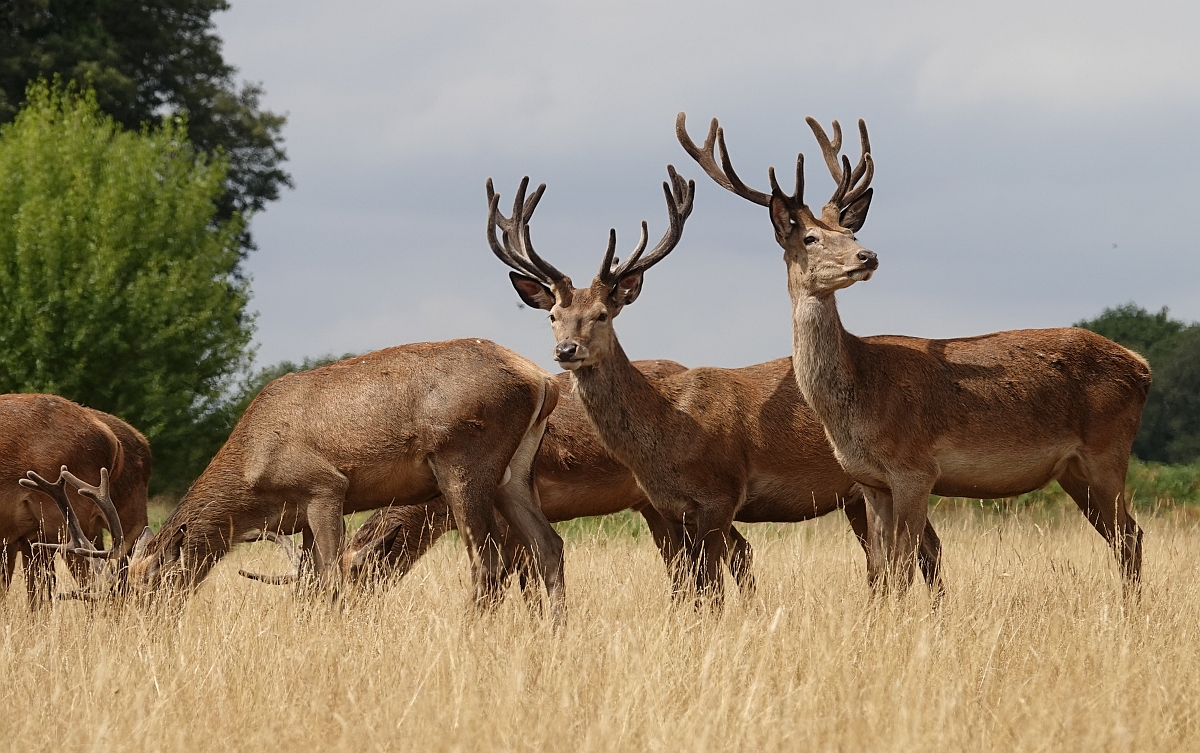
But, still I enjoyed walking in those parks and saw many wild mammals there. During morning, in Richmond park I saw one single and two herds of Red Deers (Cervus elaphus), 1 + 11 + 15 i.e total of 27, plus two Grey Squirrels (Sciurus carolinensis)

Red Deer (Cervus elaphus) herd in Richmond park


Red Deer dining on oak leaves


Red Deer staring at me


Grey Squirrel (Sciurus carolinensis) at Richmond Park


In the evening, in The Parkland Walks I saw also  two Grey Squirrels. Oh, and three Cats, which should not be there at all. In both parks I tried to find again Wood Mouse, without any success. I used even my endoscope to peek in to holes in trees and ground, but found nothing. Is year 2022 poor year for voles and mice in England?

Day 8 / 2.8.2022

No living wild mammals this day but an interesting visit to Natural History Museum, in London. Really interesting museum and worth a visit, but remember to reserve enough time for it, there are really a huge amount of things to see there.

Giant Ground Sloth (Megatherium americanum) 
in Natural History Museum


Day 9 / 3.8.2022

The last mammal observation of this trip was European Brown Hare (Lepus europaeus),
at 04:20 in street, front of our hotel, in Whitechapel, East London.

Summary:

During nine days in England I saw 20 living mammal species plus 2 other mammal species killed by traffic. The amount of living specimens was about 180. Still many lifers to wait there, like Wood Mouse (Apodemus sylvaticus), Hazel Dormouse (Muscardinus avellanarius), Lesser White Toothed Shrew (Crocidura suaveolens), Lesser Horsehoe Bat (Rhinolophus hipposideros), Bechstein's Bat (Myotis bechsteinii), Grey Long-eared Bat (Plecotus austriacus), Barbastelle (Barbastella barbastellus), Water Deer (Hydrobates inermis), Sika Deer (Cervus nippon), Risso's dolphin (Grampus griseus), Atlantic white-sided dolphin (Lagenorhynchus acutus), White-beaked dolphin (Lagenorhynchus albirostris), Humpback Whale (Megaptera novaeangliae), Fin Whale (Balaenoptera physalus) and Killer Whale (Orcinus orca). A good excuse to visit UK once again, some day.

-----------------------------------------------------------------------------------------------------------------------------

Author

Olli Haukkovaara

email: olli.haukkovaara @ proton.me

Valkeakoski
Finland

Tuesday, July 19, 2022

Väinö the Walrus ain't no more just a dream to me


Väinö the Walrus


Today, on 19th of of July 2022, at 09.59 am my phone alerted about the Walrus (Odobenus rosmarus) in Kotka. It was the same animal I got dipped out on last Saturday. I rushed to change my clothes, jumped in my car and pushed the pedal. Soon I was in Highway 3, heading to south. And after two and half hours I was in Kotka. And there it was, waiting for me, Väinö the Walrus! 

It is an amazing creature indeed! Huge, handsome, a real cosmic mind-f*cker!

At noon, it was just resting in front yard of somebody's home. Police was there already, and so was the head of local Rescue Department. At that time they let us watch the walrus from relatively close distance, about 20 meters. Later in the afternoon, when the veterinarians came, police cordoned off the area and forced mammalwatchers, photographers and and media reporters move further away.

Soon the veterinarians informed that the walrus was famished and that it had lost the grease layer under it's skin that protects it in cold water. This started a big rescue operation and during evening they managed to force the walrus to sleep, transferred it in a big truck which took the walrus to animal hospital of Korkeasaari Zoo. I really hope it survives and will be moved later to the coast of Arctic Sea, maybe to northern Norway or even Svalbard.

This Walrus is the #96 in my Global Mammal Life List and #62 in my Finland Mammal Life List. Below is some more photos of it and it's route map from Norway to Finland.


    Väinö's route, credits go to Rune Aae

-----------------------------------------------------------------------------------------------------------------------------Author

     Olli Haukkovaara 

    email: olli.haukkovaara @ proton.me 

    Valkeakoski

    Finland